
Guide
The Best Luxury Linen and Percale Sheets for Hot Sleepers
Weave, fiber and the fine print on the label: seven sets from the great bedding houses of Belgium, Italy and Massachusetts, and one better-value linen.
A purifier will not dry a damp house, and it should never add ozone to it. Here is what one does do, how to size it by the numbers, and six machines, most of them made to be seen, for rooms from the dressing room to the open-plan living room.
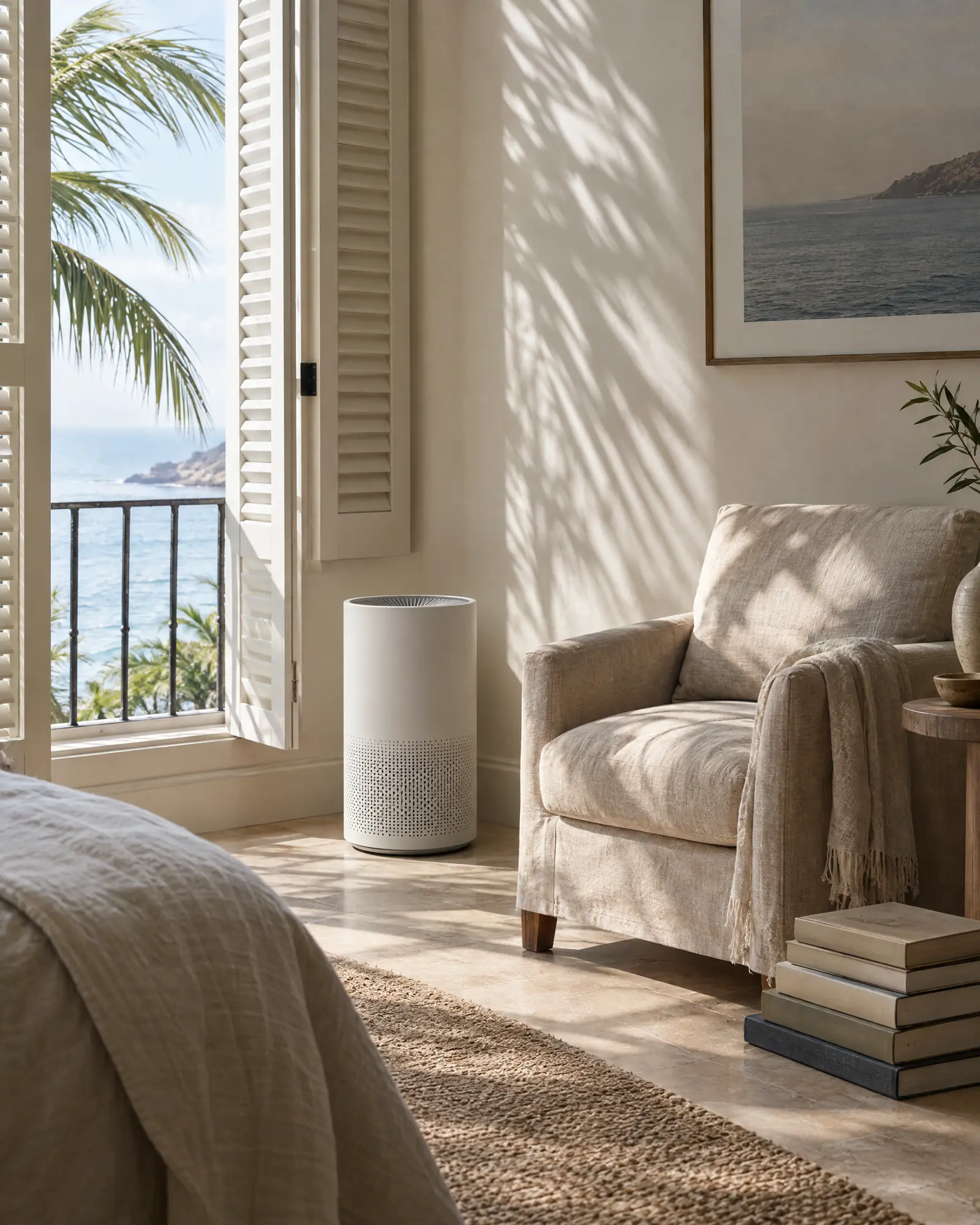
Updated October 19, 2026. We rebuilt the picks around premium and design-led machines, and we added a second ozone check against the California Air Resources Board's list of certified air cleaners. The Blueair Blue Pure 211i Max, a pick in the first version of this guide, is no longer recommended: CARB lists it as an electronic air cleaner, and HouseFresh, in its review of the Blue Pure 311i Max, reports that the ionizer in Blueair's HEPASilent system cannot be switched off 934. The Coway Airmega Mighty2 and Levoit Core 600S have made way for premium picks. The Honeywell stays, now as our one better-value pick.
We choose from published evidence: specifications, efficiency and ozone figures we read on the ENERGY STAR records, certifier listings, and reputable reviews. We have not used these products ourselves. This piece contains no affiliate links yet; when it does, they will be disclosed here.
Last checked: October 19, 2026. Clean air delivery rates, ozone figures and ENERGY STAR certification details below were read from ENERGY STAR product records. Each pick was also looked up on the California Air Resources Board's list of certified air cleaners and in AHAM's Verifide directory, and the makers' prices were read on their own US shops, all on the same day. We recheck all of it when this guide is refreshed. Reviewers' findings and makers' own figures are attributed to them by name. Honeywell's own product pages could not be opened directly when we checked, so for those we relied on their text as shown in search results.
From May to October a South Florida house is sealed against the weather. The air conditioning runs, the windows stay shut and the same indoor air goes round for months. An air purifier is a modest, useful tool for that season, provided you ask it to do the right job.
The two machines are often shelved together and do different things. A dehumidifier takes water out of the air. A portable air cleaner, which most of us call a purifier, pulls air through a filter and returns it with fewer particles in it; with a substantial carbon filter, it can also take up some gases and odors 1. It is not designed to remove moisture from the air.
The U.S. Environmental Protection Agency advises keeping indoor relative humidity below 60 percent, ideally between 30 and 50, and using air conditioners or dehumidifiers when needed 4. That is a dehumidifier's work, and our guide to dehumidifiers for coastal homes covers it.
Nor will a purifier fix mold. Asked whether portable air cleaners can solve mold problems, EPA answers plainly: no. Mold comes from a water or moisture problem; the answer is to remove the source of moisture and clean up the mold. A purifier may remove some of the particles mold releases, and in some cases may help with odors, but it will not resolve a mold and moisture problem 1. If you can smell damp, start with the dehumidifier and the leak, not the purifier.
EPA's view is measured. The most effective ways to improve indoor air are to reduce or remove the sources of pollutants and to ventilate with clean outdoor air; filtration, EPA says, can be an effective supplement to both, though no air cleaner removes every pollutant 1. Asked whether portable cleaners can ease allergy or asthma symptoms, EPA answers "possibly": multiple studies with portable HEPA cleaners found improvements in one or more symptoms, but they do not always show major improvements and not in all symptoms 1. That is a long way from the promises on some boxes. If you are buying a purifier because of allergies, asthma or another health concern, talk to your doctor first; a purifier is not a substitute for medical advice or treatment.
There is also a Florida season worth knowing about. NOAA describes the Saharan Air Layer as a mass of very dry, dusty air that forms over the Sahara in late spring, summer and early fall. In a NOAA interview, hurricane researcher Jason Dunion explains that its activity typically ramps up in mid-June and peaks from late June to mid-August, and that during that period it is common for outbreaks to reach as far west as Florida 8. NOAA's account is about the layer itself, which usually begins about a mile above the surface; we make no claim about how much of it reaches the air indoors.
The clean air delivery rate, or CADR, is the number that matters. It measures how much filtered air a machine delivers, in cubic feet per minute, and it is usually measured at the highest speed 1. Some labels give three figures, for tobacco smoke, dust and pollen, which stand in for small, medium and large particles. EPA advises choosing by the smoke figure if small particles are your concern 1.
EPA's sizing chart works out to roughly 65 cfm of CADR for every 100 square feet of floor: 130 for a 200-square-foot bedroom, 260 for a 400-square-foot living room, 390 for 600 square feet. The chart assumes eight-foot ceilings; with higher ceilings, EPA suggests sizing up, and for an open plan, counting the whole space 15. Larger models use more energy, so ENERGY STAR advises matching the machine to the room rather than simply buying the biggest 5.
Makers often quote far larger rooms, based on changing the air only once or twice an hour 1216. To compare like with like, we quote the room size given on each model's ENERGY STAR record rather than the box 7.
EPA notes that HEPA, as officially defined by the U.S. Department of Energy, describes a pleated mechanical filter that can theoretically remove at least 99.97 percent of particles at 0.3 microns, the hardest size to catch 2. Labels such as "HEPA-type", "HyperHEPA" or "medical-grade" are the makers' own terms; the ENERGY STAR record reports the filter type the maker declares 67.
CADR is for particles only. For gases and odors, EPA points to activated carbon and says it can be effective when there is a large amount of it in the filter, "the thicker the better," and that there is no widely used rating for gas removal 1. Every filter needs replacing on schedule; an overloaded one will not work well 1. Replacement cost and interval belong in the price of the machine.
EPA advises avoiding air cleaners that intentionally produce ozone, which it calls a lung irritant, and notes that electrostatic precipitators, ionizers, uncoated UV lamps and plasma devices may have the potential to emit it 1. Ozone generators sold as air cleaners have not been approved by any federal agency for use in occupied spaces, and at concentrations within public health standards, EPA says, ozone does not effectively remove viruses, bacteria, mold or other biological pollutants 3.
So we checked every pick twice. First, its ENERGY STAR record, which reports the technology the maker declares and the ozone measured under the UL 867 safety test; ENERGY STAR allows no more than 50 parts per billion 67. On our picks' records, ozone is between 0 and 1 part per billion 7. Second, the California Air Resources Board's list, which every portable air cleaner sold in California must be on. CARB classes a device as "mechanical" if it uses only physical filtration and does not generate ozone or ions, and as "electronic" if it may be capable of generating ozone; that category includes ionizers, and such devices must test at no more than 50 parts per billion 9.
The second check matters, because the two lists do not always agree: a model's ENERGY STAR record can show fan and filter only while CARB classes the same model as electronic. Five of our six picks are on CARB's list as mechanical. The sixth, the Alen BreatheSmart 75i, is listed as electronic; it carries an ionizer that you switch on and off from the control panel, and we recommend it only with the ionizer off 92123. CARB is careful to say that its certification is about ozone and electrical safety, not about how well a machine cleans the air or whether it is "safe to use" 9.
AHAM, the appliance manufacturers' association, keeps a directory of models whose CADR has been verified by an independent laboratory 10. Of our picks, only the Honeywell is in it; IQAir, Coway and Alen are not among the directory's brands 10. For the others, the CADR we give is the one on the ENERGY STAR record, which ENERGY STAR requires to be measured to the AHAM test method 67.
EPA suggests a model with a low published noise rating if noise might stop you running it, and offers a reference point: about 50 decibels is roughly the sound of a modern refrigerator 1. Makers publish noise unevenly, so we give an independent measurement where one exists. On energy, ENERGY STAR says certified room air cleaners are more than 50 percent more energy-efficient than standard models 5. EPA adds that the ENERGY STAR label is about energy only, not about how well a machine cleans the air 1.
Past a point, a higher price buys less air than you might think. What it can buy is materials and finish, quieter running at the speeds you will actually use, longer guarantees and, often, dearer filters; not every premium machine has smarter controls (three of our picks have no app). The IQAir Atem Earth, for example, delivers about the same smoke CADR on its ENERGY STAR record as the Coway Airmega 400, which costs less 1124. Budget for filters too: across our five premium picks, a replacement filter or set costs from $54 to $199 at the makers' current prices 1317212629.
Your central system's filter also cleans air, but only while the system is running. EPA recommends a filter rated at least MERV 13, or as high as your system can take, and suggests asking an HVAC technician what yours will accommodate 1. A portable purifier is for the rooms you use most.
Chosen from published evidence: ENERGY STAR records and CARB listings for all six, independent reviews for five (we found none yet for the Honeywell), and makers' own figures, attributed to them. The first five are premium machines, weighed for how they are made and how they will look in a room as well as for the numbers; the last is our one better-value pick. Grouped by room: one for a living room or study, one for open-plan spaces, two for large rooms, one for a primary bedroom and one for a small bedroom. None was used or tested by us. EPA neither certifies nor recommends particular brands 1; the picks are ours, not EPA's, ENERGY STAR's or CARB's. CADR figures are smoke, dust and pollen, in cubic feet per minute. Prices are the makers' own US prices on October 19, 2026, and will change.
Why it earns a place. The most considered object in this guide. IQAir builds the Atem Earth's housing from sustainably sourced beech wood with a natural, paint-free finish, says it uses five times less plastic than conventional purifiers, and offers a 25-year maintenance and repairability guarantee 12. Live Science called it "the most elegant, eco-friendly air purifier we have ever tested" and found it quiet and effective, but judged its app and air quality monitoring too basic to justify the price 14.
The numbers. CADR 369 / 382 / 423 and a room size of 572 square feet, ozone 0 parts per billion, fan and filter only, ENERGY STAR certified (not designated Most Efficient), per ENERGY STAR record 4016351 (checked October 19, 2026) 11. That record is for a model named "ATEM E", the only IQAir model in ENERGY STAR's list. IQAir says the Atem Earth is ENERGY STAR certified, and its page for the Atem Earth links the user manual under the name "Atem E" 12, so we take this to be its record. CARB lists IQAir's Atem E as mechanical 9. IQAir quotes 1,460 square feet at two air changes an hour and 16 to 56 decibels across its six speeds 12; at top speed Live Science measured about 55 decibels with a phone app 14.
Filter. A single HyperHEPA particle filter with an activated carbon post-filter, which IQAir rates for up to 12 months 1213. Filter: $99.99 at IQAir 13.
Price. $999 at IQAir's US shop (checked October 19, 2026) 12.
Who it suits. A living room, library or primary suite of up to about 570 square feet, by its ENERGY STAR room size, where the machine will be on show. Made in Switzerland, according to IQAir 12. IQAir's European sites would not open for us when we checked in October 2026, so we could not confirm a European stockist or price.
Why it earns a place. The most capable machine here, for open-plan spaces and double-height rooms; Coway itself describes it as designed for businesses 16. HouseFresh admits the ProX "isn't cheap, is heavy and takes up a lot of space" but calls itself "a big fan", praising its balance of power and quiet and noting that Coway has dropped the ionizer found on some older models 18. Tom's Guide calls it one of the biggest and most expensive room purifiers on the market and notes that it has no app, remote or voice control 19.
The numbers. CADR 577 / 586 / 450 and a room size of 894 square feet, ozone 0 parts per billion, fan and filter only, ENERGY STAR certified and designated Most Efficient, per its ENERGY STAR record (checked October 19, 2026) 15. CARB lists it as mechanical 9. HouseFresh measured 37.4 decibels at its lowest speed and 53.6 at its highest, from three feet 18.
Filter. Two bonded carbon and HEPA filters, one on each side 18; Coway's specifications give them a life of one year, though the same page also says "up to 6 - 12 months" 16. Filter set: $199 at Coway 17.
Price. $999 at Coway's US shop (checked October 19, 2026) 16.
Who it suits. A great room with a high ceiling, a ground floor planned as one space, or a large house where one machine must do the work of two. Coway says the Airmega models on its US site are sold for use in the United States only 16. We did not find a European version of the ProX when we checked in October 2026.
Why it earns a place. A large-room machine for a household whose main complaint is odor, with front panels that can be swapped to suit a room. HouseFresh, which updated its review with test results for the V2, concludes that "for those looking for an air purifier for dealing with odors and VOCs in rooms up to 500 square feet, the Alen BreatheSmart 75i could be worth the $799 investment," and that without serious odor problems "it might be overkill"; its other complaints are a higher price than machines with the same performance, its size and a bare-bones app 22. TechRadar found it powerful for large spaces and easy to use, if a bit loud on its higher settings, and liked that the front panel can be changed to match your decor; its review does not say which version it tested 23.
About the ionizer. The 75i has an ionizer that you switch on and off from its touch control panel 2123; the manual for your unit shows which control it is. Alen gives its ozone output as zero with the ionizer off and less than 0.001 parts per million with it on 21, and CARB lists the 75i V2 as an electronic air cleaner 9. Given our rule on ions, we recommend it only with the ionizer off. We could not confirm whether the ionizer is on or off when the machine is first switched on, or whether it keeps your setting after being unplugged or after a power cut. So when you set it up, check the control panel and turn the ionizer off if it is on, and check again after any power cut. If you would rather not have to, choose one of the other picks.
The numbers. CADR 370 / 351 / 431 and a room size of 574 square feet, ozone 1 part per billion, fan and filter only on its ENERGY STAR record, ENERGY STAR certified (not designated Most Efficient), per the record for the BreatheSmart 75i_V2 (checked October 19, 2026) 20. The record is for the V2; check that the listing or box says V2. HouseFresh measured 36.5 to 57.5 decibels across its speeds 22.
Filter. Alen sells a HEPA filter, which its specifications rate for a maximum of 12 to 15 months of round-the-clock use (its FAQ says to replace it every 10 to 12 months), and two carbon versions for odors, rated for a maximum of 7 to 10 months 21. Filter: from $99 at Alen 21.
Price. $799 at Alen's US shop (checked October 19, 2026) 21.
Who it suits. A living room or open kitchen up to about 575 square feet, by its ENERGY STAR room size, where cooking or other odors are the main concern. We did not find a European stockist when we checked in October 2026.
Why it earns a place. The understated alternative to the ProX for a room of up to about 580 square feet: a long-established machine with a generous combined carbon and HEPA filter on each side. RTINGS suits it to large living areas, open-plan spaces and primary bedrooms; it has no app and takes up real floor space 27.
The numbers. CADR 376 / 384 / 409 and a room size of 583 square feet, ozone 0 parts per billion, fan and filter only, ENERGY STAR certified, per its ENERGY STAR record (checked October 19, 2026) 24. CARB lists it as mechanical 9. Coway's own page quotes lower figures; we give the record's 2425. RTINGS measured 31.6 dBA at its lowest fan speed and 60.1 dBA at its highest 27.
Filter. Two Max2 filters, one for each side, each combining activated carbon and HEPA; Coway says they last "up to 6 - 12 months", and about a year in its specifications 2526. Filter set: $129 at Coway 26.
Price. $649 at Coway's US shop (checked October 19, 2026) 25.
Who it suits. A living room or open area of up to about 580 square feet, by its ENERGY STAR room size, where an app does not matter. We did not find a European version of the Airmega 400 when we checked in October 2026.
Why it earns a place. The quiet, compact member of Alen's premium range, for a primary bedroom or dressing room. Alen lists it with no ionizer and dims its control panel automatically in a dark room 29. HouseFresh calls it "one of the best small air purifiers I have reviewed", with a caveat: for the same money you can buy a more powerful mid-sized machine from Levoit or Coway 30.
The numbers. CADR 150 / 164 / 195 and a room size of 233 square feet, ozone 0 parts per billion, fan and filter only, ENERGY STAR certified (not designated Most Efficient), per its ENERGY STAR record (checked October 19, 2026) 28. CARB lists it as mechanical 9. HouseFresh measured 36.4 to 52.6 decibels across its speeds 30.
Filter. Alen's HEPA filter, which its specifications rate for a maximum of 9 to 12 months of round-the-clock use (its FAQ says every 6 to 9 months, depending on use), with carbon versions for odors 29. Filter: from $54 at Alen 29.
Price. $289 at Alen's US shop (checked October 19, 2026) 29.
Who it suits. A primary bedroom, dressing room or study up to about 230 square feet, by its ENERGY STAR room size. We did not find a European stockist when we checked in October 2026.
Why it earns a place. Our one better-value pick, and the smallest and simplest machine here, for a guest bedroom, study or dressing room. Its ENERGY STAR record lists fan and filter as the only technology, reports its ozone as 0 parts per billion and designates it Most Efficient 31. It is the one pick whose CADR also appears in AHAM's Verifide directory, at the same figures 10. Honeywell describes it as a purifier for small rooms such as bedrooms and home offices, with a sleep mode that dims its lights 32. It has been on the market only since July 2026, according to its record 31, and we have not found an independent review of it; it is here on its ENERGY STAR and AHAM records and Honeywell's own description, and we will add a reviewer's findings when one is published.
The numbers. CADR 109 / 117 / 117 and a room size of 169 square feet, ozone 0 parts per billion, fan and filter only, ENERGY STAR certified and designated Most Efficient, per the ENERGY STAR record for model HPA4100B (checked October 19, 2026) 31. The record also covers model HPA4100W; it lists an air quality sensor for automatic mode and no Wi-Fi connection 31. CARB lists the HPA4100B and HPA4100W as mechanical 9. Honeywell's page gives no decibel figure 32, and we found no independent measurement (checked October 2026).
Filter. The HRFY1 filter, which Honeywell describes as combining a vacuumable pre-filter, a HEPA layer and an activated carbon layer; Honeywell's page for the filter advises replacing it every 9 to 12 months 33. The ENERGY STAR record lists the filter type as HEPA 31. Filter: Honeywell does not show a price on its page 33, and we did not find the HRFY1 for sale at Amazon or Walmart when we checked on October 19, 2026.
Price. Honeywell does not show a price on its page 32, and we did not find the HPA4100B for sale at Amazon, Walmart, The Home Depot or Best Buy when we checked on October 19, 2026.
Who it suits. A bedroom, study or guest room up to about 170 square feet, by its ENERGY STAR room size; not a living room. The record lists it for the United States and Canada 31; we did not find a European version when we checked in October 2026.
Some of the most talked-about names in premium air purifiers are missing. That is not a finding about how well any of these machines work or whether they are safe; we have not tested them, and neither have we tested our picks. It means that, on the public records this guide screens and sizes by, they did not fit our two rules: a fan-and-filter machine, and a CADR on an ENERGY STAR record (or in AHAM's directory) to size it by. These are the records as we read them on October 19, 2026; they change, and we will look again when we refresh this guide.
Read the manual for your exact model number; it is the only authoritative schedule.
Sources checked 2026-10-19.
Guide
Weave, fiber and the fine print on the label: seven sets from the great bedding houses of Belgium, Italy and Massachusetts, and one better-value linen.
Guide
Disclosed waxes and wicks, and scents that know when to stop. What the word "fragrance" hides on a label in the US and Europe, what a candle maker can tell you and often doesn't, and five perfumes and candles from houses that show their work.
Guide
Room by room, the everyday things worth replacing with something better made, better disclosed and built to last.
Guide
Six face-care formulas from houses that publish their full ingredient lists, from a $75 eye cream to a $315 jar. How to read a luxury ingredient list, what the seals on the box really certify, and why the price is never the proof.

Guide
Stainless, cast iron, enameled iron, carbon steel and ceramic, what each asks of the cook, and seven pieces from the great French, Belgian, Italian and American makers, with one better-value skillet.
Guide
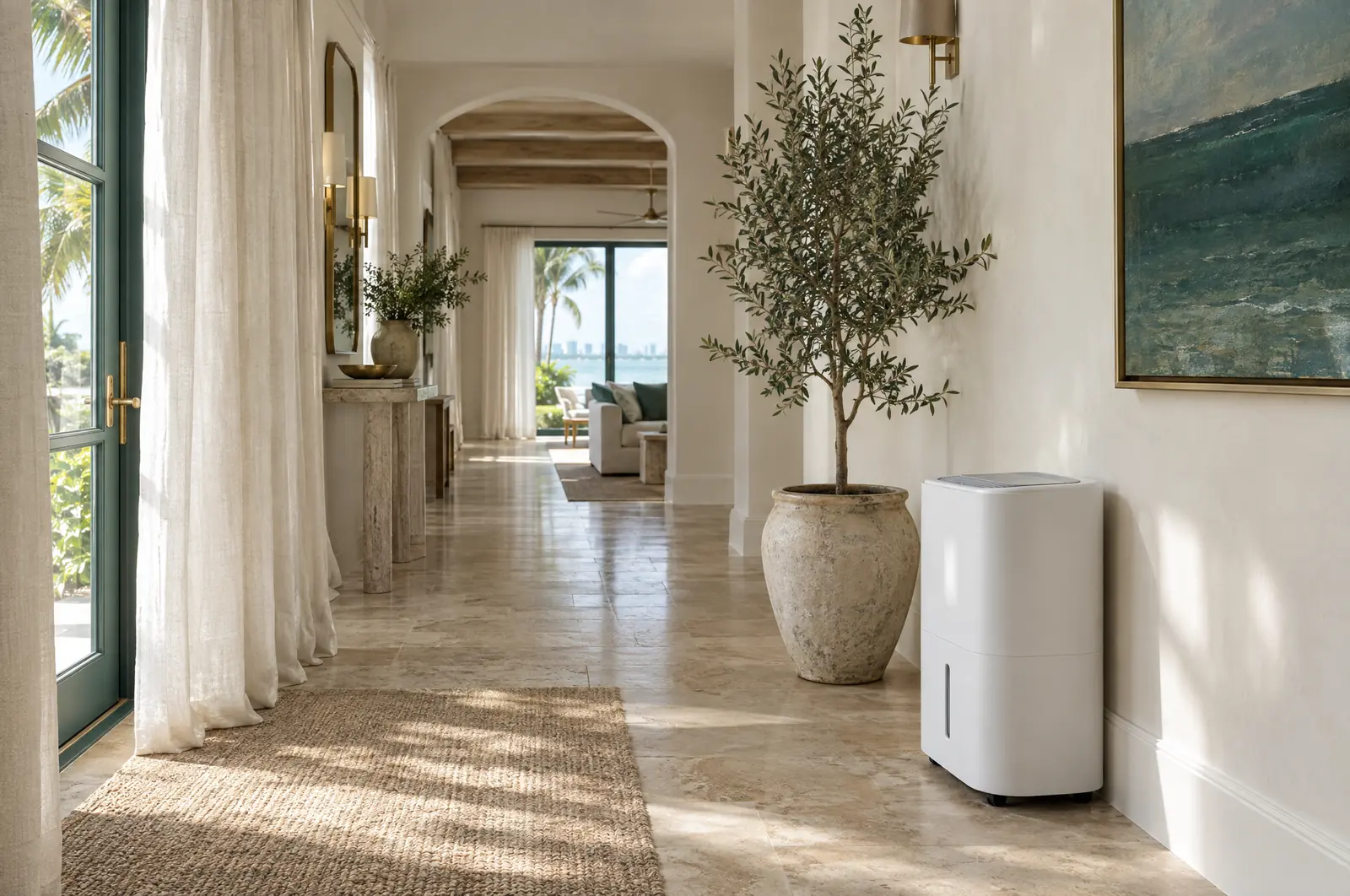
In a house that breathes sea air for most of the year, drying it is a matter of numbers. Here is how to read them, and seven machines worth a look, led by the systems that disappear into the house.

Guide
Seven hotels, from the historic spring towns of Baden-Baden, Bad Ragaz, Évian and Saturnia to the high Alps, chosen for what they publish about their water, energy, kitchens and spas, with the seasons they keep and how to reach them.
Guide
Behind the green cross, a short shelf of quiet, well-made basics, and five French houses that take the same idea to the salon, the spa and the department store. What they are, what is in them, and where to find them on either side of the Atlantic.

Explainer
The ingredient list, the fine print and the seals: what each one is actually telling you, and what it isn't.
Guide
Seven unhurried days by boat and on foot: three lakeside hotels chosen for what they publish about their gardens, kitchens and spas, three historic gardens, MICHELIN-listed tables, and how to move, swim and boat safely on the lake.

Guide
Zinc, titanium and the prestige formulas worth carrying to the beach in a Florida summer: seven picks read from their Drug Facts labels, and a straight answer on reef safe.

Explainer
What federal health and environmental agencies advise once the water recedes, in the order you will need it.

Guide
Wool, jute, sisal, seagrass, silk and cotton underfoot in a humid house: how each fiber behaves with damp and moths, what is on the back, what the labels mean when you look them up, and seven rugs from houses that say what they are made of.
Guide
Frames, fabrics and finishes that belong on a coastal terrace: teak and FSC, 316 versus 304 stainless, powder-coated aluminum, solution-dyed acrylic, woven fiber and quick-dry foam, with seven pieces from the great outdoor houses and what to do when a storm is coming.

Guide
Where to stay, eat, swim and walk over two unhurried days, chosen from what the island's hotels, kitchens and gardens publish about themselves.

Guide
Seven hotels from Jupiter to Boca Raton, chosen for what they publish about their spas, kitchens, water and footprint, and, where a hotel holds one, for the certification or verification we could confirm on the certifier's own records.
Guide
Seven grand hotels by the Mediterranean, chosen for what they publish about their gardens, kitchens, spas and footprint, with the seasons they keep and how to reach them.
Explainer
A reassuring word with no fixed meaning, and the better questions to ask instead.
Weekly, free
One considered pick, one beautiful find, one Palm Beach moment and one good deal, every week.